

Executive Summary
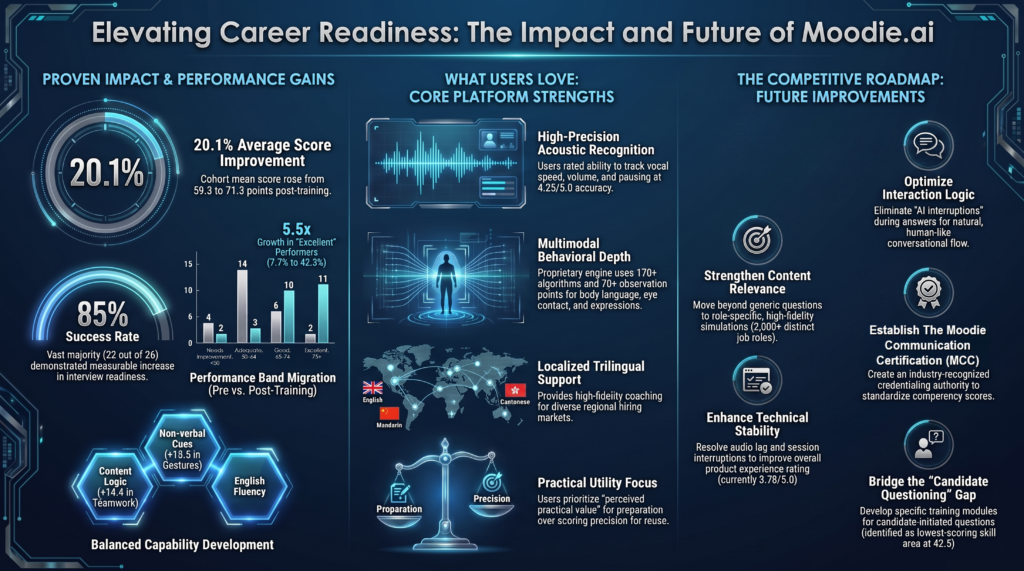
Moodie.AI, developed by Hong Kong’s Datality Lab, is a SaaS-based AI communication and interview training platform utilizing a proprietary multimodal AI agent. An empirical evaluation of the platform, conducted with business students from The Chinese University of Hong Kong (CUHK), confirms its effectiveness in improving interview performance. Key findings include an average 20.1% increase in user scores following a single training cycle, with 85% of participants demonstrating measurable improvement.
While the platform excels in recognizing vocal attributes and non-verbal cues (gestures, expressions), it faces challenges regarding technical stability and “candidate-initiated questioning” modules. Strategic analysis reveals that user retention and recommendation are driven primarily by perceived practical value rather than scoring precision. Compared to global competitors, Moodie.AI occupies a defensible niche in the East Asian market through deep institutional partnerships and specialized multimodal algorithms. To maintain market leadership, the platform must prioritize technical stability, role-specific customization, and the establishment of industry-standard certifications.
1. Platform Overview and Methodology
1.1 About Moodie.AI
Moodie.AI is a communication training system designed for mock interviews, sales presentations, and public speaking. It supports English, Cantonese, and Mandarin and employs a hybrid B2B/B2C business model.
- Technology Stack: Proprietary engine featuring 170+ algorithms and 70+ observation points.
- Assessment Metrics: Multi-modal analysis covering body posture, volume, vocal pace, logic, and professional knowledge.
- Institutional Partners: CityU, SMU, CUHK, HKMU, and regional government bodies (HKPC, IMDA).
1.2 Research Methodology
The evaluation utilized a three-step intervention workflow:
- First Mock Interview: Baseline assessment of content, non-verbal, and language skills.
- Debrief & Training: Diagnostic reports and targeted video training.
- Second Mock Interview: Re-assessment under the same framework for paired comparison.
Sample Data:
- Performance Dataset: 26 candidates (7 Consultants, 9 Product Managers, 5 Data Analysts, 5 IT Programmers).
- Survey Dataset: 32 respondents (predominantly Master’s students from QS Top 100 institutions).
2. Analysis of Training Effectiveness
2.1 Quantitative Performance Uplift
The intervention resulted in a significant upward shift in interview competency across the cohort.
- Mean Score Increase: Rose from 59.3 to 71.3 (+12.0 points).
- Improvement Rate: 85% of candidates improved their scores.
- Score Distribution Migration: The “Excellent” (75+) band grew from 7.7% to 42.3% of the sample, while the “Adequate” (50–64) band contracted significantly.
2.2 Performance by Role and Language
| Group | n | Mock 1 Mean | Mock 2 Mean | Net Gain |
| Consultant | 7 | 56.6 | 74.6 | +18.0 |
| Product Manager | 9 | 58.0 | 71.4 | +13.3 |
| Data Analyst | 5 | 61.5 | 70.2 | +8.7 |
| IT Programmer | 5 | 63.4 | 67.6 | +4.2 |
| Mandarin Track | 17 | 57.1 | 69.1 | +12.0 |
| English Track | 8 | 64.6 | 75.0 | +10.5 |
- Consultants saw the highest gains, likely due to a lower baseline and a strong alignment between training content and consulting-specific communication needs.
- IT Programmers saw the lowest gains, attributed to a higher initial baseline and compressed “headroom” for improvement.
2.3 Skill Dimension Gains
- Non-Verbal Skills: Showed the largest and most variable improvements, specifically in Gestures (+15.5), Facial Expressions (+14.7), and Eye Contact (+13.5).
- Interview Content Skills: Balanced gains across dimensions like Teamwork & Project Management (+14.4) and Problem Solving (+14.7).
- Critical Gap: “Candidate Questions” (the ability of the interviewee to ask insightful questions) remained the lowest-scoring area at 43.5, despite improvements.
3. User Sentiment and Perception
3.1 Aggregate Ratings
Users rated the platform on a 5-point Likert scale (for accuracy/experience) and a 0–10 Net Promoter Score (NPS) scale (for value/intent).
| Dimension | Mean Rating | Interpretation |
| English Competency | 4.13 | Highest endorsement; strongest user confidence. |
| Non-verbal Expression | 4.09 | Solid; acoustic items (volume/speed) rated highest at 4.28. |
| Core Prof. Ability | 4.07 | Consistent and above average. |
| System Overall Exp. | 4.04 | Lowest and most inconsistent; flags technical friction. |
3.2 Core Pain Points
- Technical Stability: The lowest-rated individual item (3.78). Users reported lag, session interruptions, and audio/video desynchronization.
- Content Specificity: Users noted that interview questions were occasionally too generic and lacked role-specific depth.
- Interaction Logic: Issues with “random AI interruptions” during user answers were identified as a significant experience flaw.
4. Drivers of User Attitude and Retention
Regression and mediation analyses were employed to identify what truly drives user intention to recommend or continue using the platform.
4.1 The Primacy of “System Experience”
Analysis reveals that accuracy in scoring (how well the AI assesses English or non-verbal cues) does not significantly predict user recommendation or continued use. Instead, System Overall Experience is the only significant predictor across all outcomes (Core Competency Reflection, Perceived Practical Value, Recommendation, and Usage Intention).
4.2 The Mediation Path
The relationship between the user experience and behavioral intent is fully mediated by Perceived Practical Value.
- Mechanism: Better System Experience → Higher Perceived Usefulness → Higher Retention.
- Strategic Implication: Polishing the surface experience (stability, usability) is more effective for retention than marginal increases in scoring precision. Users value the platform as a practical practice tool rather than a perfect scientific instrument.
5. Competitive Landscape
5.1 Moodie.AI SWOT Summary
- Strengths: Deep East Asian localization (Cantonese/Mandarin); high-barrier institutional integrations; 170+ proprietary algorithms.
- Weaknesses: Lack of public social proof (G2/Capterra); opaque B2C pricing; technical instability compared to global rivals like Yoodli.
- Opportunities: Credentialing (MCC certification); establishing an Asian campus recruitment benchmarking database.
- Threats: Rapid commoditization of LLM infrastructure; aggressive anti-AI detection by employers (targeting “Copilot” competitors but affecting the broader niche).
6. Strategic Recommendations
Based on the synthesis of performance data and user feedback, the following actions are prioritized:
Priority 1: Technical and Content Fundamentals
- Stabilize Infrastructure: Eliminate audio/video lag and desync. This is the single highest-leverage area for improving perceived value.
- Strengthen Questioning Module: Integrate a training block specifically for “candidate-initiated questioning” frameworks and industry-specific example banks.
Priority 2: Value Deepening
- Role-Specific Customization: Shift from generic evaluation to position-tailored feedback (e.g., specific metrics for Consultants vs. Data Analysts).
- Quantify Non-Verbal Feedback: Provide granular data such as “eye-contact seconds” or “gesture frequency” to make the assessment feel more objective and actionable.
Priority 3: Strategic Moats
- Establish Moodie Communication Certification (MCC): Create an industry-recognized standard to differentiate from uncertified tools.
- Aggregate Benchmarking Data: Use data from institutional partnerships to allow users to compare their readiness against regional peer benchmarks, creating a unique network effect.